

Told You're "Too Sensitive"? Here's What's Actually Happening.
Your body isn't broken. It's responding exactly as it should to a world it learned wasn't safe. Why some pills are too strong, some protocols backfire, and your nervous system isn't broken—it's stuck.

If you’ve ever been told you’re “too sensitive”—that your fatigue, your headaches, your weird inflammatory flares are “all in your head”—I want you to hear something.
Your body is not broken.
It’s doing exactly what it was designed to do. It’s keeping you alive.
That supplement that made you feel worse? That protocol everyone else thrived on that knocked you flat? That’s not a sign something is wrong with you.
It’s a sign your nervous system is operating with exquisite precision—responding to a world it learned, somewhere along the way, was not safe.
I Spent My Teenage Years in a Cult. Here’s What It Did to My Nervous System.
I’ll tell you a piece of my story—not because it’s worse than anyone else’s, but because it might help you see something in yours.
I spent my teenage years in a cult. At 15, I was placed in a program where I carried adult responsibilities. In that world, mistakes weren’t learning opportunities. They were triggers for punishment. If you stumbled, you were shunned—frozen out until you’d done enough to earn belonging again.
I learned that safety was conditional. That visibility was dangerous. That if I was perfect, I might be okay. If I was useful, stayed quiet and small, I might be left alone.
I left that environment decades ago. I’ve built a life, a career, a family. From the outside, I’m “fine.”
Until recently, I carried that program with me. My nervous system was still scanning for punishment. Still bracing for the mistake. Still running strategies that made sense when I was fifteen and trying to survive.
As I’ve been doing the trauma healing with own ThetaHealing® practitioner, I’ve gained so much more awareness around how you can seem fine—feel fine, even—while your nervous system is anything but balanced. We’ve been clearing and releasing these old programs, and it’s been so freeing.
That experience is part of why I’m writing this. If you’ve had trauma—any kind of trauma—I want to share what you can do about it.
Maybe This Sounds Familiar
You don’t have to have grown up in a cult for your nervous system to have learned that safety is conditional.
Trauma isn’t always what we think it is. When we hear that word, most of us picture something catastrophic—a car accident, violence, a major loss.
But the nervous system doesn’t rank experiences by how dramatic they look from the outside. It ranks them by whether you felt safe.
Childhood patterns. A critical parent. Unpredictable moods in the house. Being the “good kid” who kept the peace. Learning early that your needs came last.
School experiences. Bullying. Social rejection. Being the kid who didn’t fit in. Teachers who shamed. Peers who excluded. Learning that belonging could be revoked without warning.
Medical trauma. Painful procedures. Doctors who dismissed you. Being told “there’s nothing wrong” when you knew there was. Learning that your own experience couldn’t be trusted.
Religious or institutional trauma. Environments where rules were rigid, punishment was disproportionate, belonging was conditional. Where one mistake could get you frozen out.
Family role trauma. Being parentified young. Carrying adult responsibilities as a child. Learning to read the room before you learned to read books.
Relational trauma. Relationships where love was earned through performance. Friendships that punished authenticity. Dynamics where you learned to shrink.
The accumulation of modern life. Juggling more than any human should. Running at full capacity for so long that your baseline became survival mode—even if it didn’t look like crisis from the outside.
Here’s the thing: you might not call any of this “trauma.” You might call it “just life” or “everyone had it hard” or “it wasn’t that bad.”
But you shoved it down. Compartmentalized it. Kept going. Because that’s what you do.
Until one day, you can’t.
When “Fine” Isn’t Actually Fine
One of the sneakiest things about a dysregulated nervous system is that it doesn’t always feel dramatic.
When someone has a history of significant stress—or even the slow accumulation of “manageable” stress over years—but reports feeling neither anxious nor depressed, neither hyper-aroused nor numb... they’re often existing in a state of high-functioning compensation.
The nervous system has essentially hard-wired a state of stability that isn’t true calm. It’s a rigid, defensive posture that the body has mistaken for normal.
You might not feel “stressed.” You might feel... busy. Responsible. The person everyone relies on.
You might not feel traumatized. You might feel... capable. High-functioning. The one who handles things.
But the body remembers what the mind has learned to ignore.
The Signs Your Nervous System Is Stuck (Even When You Feel “Fine”)
If you don’t “feel” stress, you have to look for the biological echoes of a dysregulated system.
Sleep architecture. You might fall asleep fine, but are you waking up at 2am or 3am consistently? This is often a sign of a cortisol spike—the nervous system scanning for threats even during rest. Quality matters more than quantity.
Heart rate variability. HRV is the gold standard for objective nervous system assessment. Low HRV indicates the system is locked in a rigid pattern, lacking the flexibility to shift between states. You can sleep eight hours and still wake exhausted because your nervous system never actually rested.
Digestive function. Chronic bloating, food sensitivities, irregular motility. The gut is the “second brain.” When the body is prioritizing survival, it diverts resources away from digestion. You might not feel stressed, but your gut knows.
Physical tension patterns. Jaw clenching. Shallow breathing. Chronic tension in the shoulders, neck, or pelvic floor. This is the nervous system physically bracing against an environment it still perceives as unsafe—even when your conscious mind knows better.
The startle reflex. How do you react to sudden noises or unexpected movements? An exaggerated startle response—even if you feel calm seconds later—is a hallmark of a system stuck in low-level hypervigilance.
Recovery time. One stressful conversation and you need a day to bounce back. One late night and you’re off for a week. The system lacks the resilience to return to baseline.
Sensitivity to inputs. Supplements hit too hard. Coffee makes you jittery. Crowds are draining. Noise is overwhelming. Everything feels like too much.
This is what a stuck nervous system looks like in everyday life. You’re not high-functioning. You’re high-survival. And your body is running out of reserves.
Why You’re “Too Sensitive”
When your nervous system has been running in survival mode for years—maybe decades—it doesn’t just “snap back” when the threat is removed. The thermostat gets stuck.
Your system has learned that threats are everywhere. That the environment can’t be trusted. That it must stay vigilant—checking for danger, mobilizing resources, preparing for the next crisis.
So when you introduce something new—a supplement, a food, a detox protocol—your system doesn’t say, “Oh good, support.”
It says, “THREAT.”
The pill that’s supposed to help? Your body reads it as one more thing to process, one more demand on an already overtaxed system.
The protocol everyone else loves? Your sensitized nervous system experiences it as an assault.
This is not weakness. This is precision.
Your body is doing exactly what it was wired to do. It’s protecting you based on what it learned—even if what it learned no longer applies.
🎯 The Broken Thermostat
(Quick confession: I used to think nervous system stuff was kind of woo. Just breathe more? Do some tapping? Really?)
Then I got sick. I bootstrapped my way back to health using protocols—supplements, cleanses, liver support, all the very physical work. And it helped. A lot. But getting all the way better required addressing the nervous system and trauma layer underneath.
Here’s a metaphor that helped me:
Imagine your thermostat is set to 68 degrees. When the temperature rises, the AC kicks on. When it drops, the heat comes on. The system regulates itself.
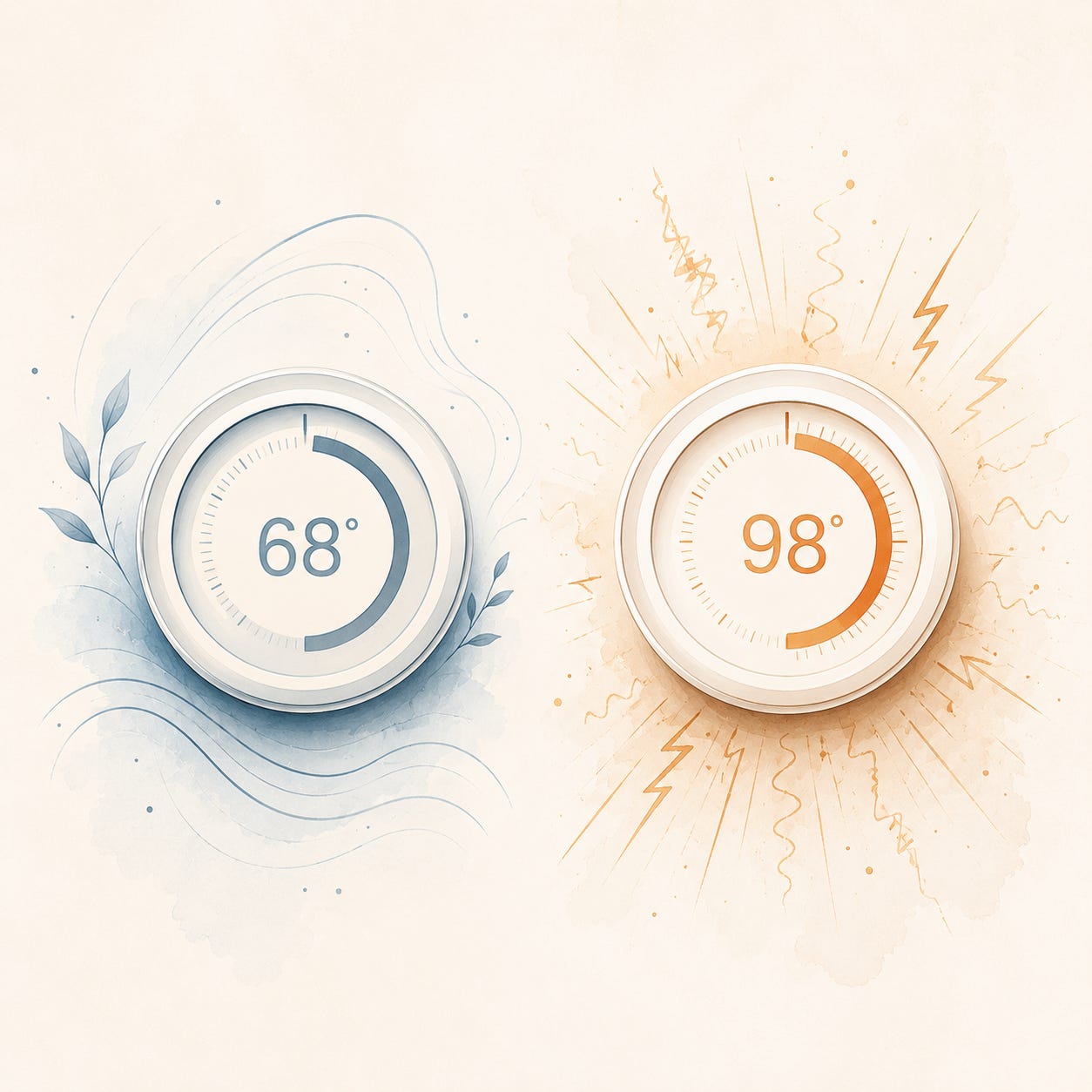
Now imagine someone cranked your thermostat to 98 and superglued it there.
The AC runs constantly. The system never rests. It’s working perfectly—according to its settings.
But the settings are wrong.
That’s a sensitized nervous system. It’s not broken. The thermostat is just stuck.
The slightly less good news? The thermostat doesn’t reset overnight.
The better news? It can reset. Slowly, gently, with the right signals.
The Compounding Effect: When Trauma Meets Toxic Load
Here’s where it gets more complicated—and more important.
Environmental stressors aren’t just “add-ons” to trauma. They’re physiological triggers that keep the nervous system trapped in a loop of inflammation and defense.
Stealth infections and toxins (chronic viral reactivation, mold exposure, Lyme and co-infections) don’t just affect your lungs or your blood. They cross the blood-brain barrier. They trigger microglial activation—the brain’s immune cells going into permanent attack mode.
When the brain is inflamed, the nervous system can’t distinguish between an external threat and an internal one. It defaults to survival. Which shuts down higher-order processing and keeps you in chronic, low-level fight-or-flight.
Chemical and heavy metal toxicity disrupts neurotransmitter signaling and mitochondrial function. If your cells can’t produce energy efficiently, your nervous system lacks the biological resources to “switch gears.” You become stuck in a rigid state because you literally don’t have the energy to relax.
The liver and kidneys get overwhelmed. When detoxification pathways are backed up, the body experiences systemic inflammation. The brain senses this inflammation as a threat, forcing the nervous system to stay defensive.
Trauma creates a sensitized system. Environmental toxins and stealth infections pour gasoline on that fire. The body becomes so preoccupied with managing the chemical and pathogenic load that it loses capacity for self-regulation.
You can’t feel the stress anymore. You’re too overloaded to register anything other than the status quo.
Why You’ve Been Dismissed
If you’ve felt dismissed by doctors or told to “just relax,” here’s why:
Most medical training doesn’t include nervous system sensitization. Practitioners are taught to find the pathogen, fix the deficiency, suppress the symptom.
When your labs look normal but you feel terrible? When the standard dose makes you worse? When you’re “too sensitive” to tolerate what works for everyone else?
That doesn’t fit the model. So you get labeled “difficult” or “anxious” or told it’s all in your head.
It’s not in your head. It’s in your nervous system. And it’s real.
What you need isn’t more protocols. You need a system that’s safe enough to receive support.
The Path Forward: Restoring Safety
You can’t force a stuck nervous system to relax. But you can send it consistent signals that it’s safe to stand down.
This happens in layers:
1. Stop relying on “feeling” fine. Use objective data—HRV tracking, sleep quality, recovery time—to see what your physiology is actually doing.
2. Address the biological burden. If the system is overloaded by toxins, mold, or chronic infections, no amount of breathwork will fix it. You have to give the nervous system breathing room by supporting detoxification and clearance.
3. Go slow. Because a sensitized system is hyper-reactive, aggressive protocols backfire. Introduce changes one at a time, at sub-threshold doses, to see how your nervous system responds before adding more.
4. Stack safety signals. Your body needs repeated proof that it’s okay to relax. Not one meditation. Not one good night’s sleep. Consistent, layered signals that accumulate over time.
What’s in the Rest of This Article
Paid subscribers get the exact steps, recipes, and photos to start resetting your nervous system:
Why minerals are critical—and how to take them without your body screaming “too much” (the sub-threshold approach that finally lets sensitized systems absorb support)
The safety signal stack — four simple tools layered throughout your day that teach your nervous system it’s actually okay to stand down
The research on ear seeds, cortisol, and anxiety — why this underutilized tool works around the clock while you live your life
The exact ear seed protocol with photos and point locations — no guessing, just place and press
A mineral bath recipe designed for sensitive systems — phased so you don’t end up wired or wiped out
A timing guide for stacking your daily safety signals — when to do what, so it becomes second nature instead of one more thing to figure out
Start with Minerals
When your nervous system has been running in survival mode for years, your body burns through nutrients at an accelerated rate.
Magnesium gets depleted keeping your muscles braced and your heart pounding. Zinc gets burned fueling the stress response. Trace minerals get used up just keeping you upright.
After years of this, your battery isn’t just low. It’s structurally depleted.
Minerals are the electrical wiring of your nervous system. Without adequate mineral status, the “current” running through your system is erratic. You feel wired but exhausted. Anxious but depleted. The system lacks the foundational conductivity to shift out of fight-or-flight and into rest-and-repair.
